


UPDATES
Hey! Hope you all are doing well!
I Think ASI is Imminent
Biggest thing I want to share is that I think we’re about to hit ASI very quickly. Like maybe next year. I’d put it at like a 75% chance we hit it in 2027. I’ll be doing a video on why I think this very soon.
Now, of course, the whole thing depends on what definition you use for ASI. My practical definition of AGI is that it’s good enough at it to replace an average knowledge worker. Here are my more general definitions.
AGI: Can perform any cognitive role as good as a human expert in that field.
ASI: Can perform any cognitive role better than any human expert ever.
So ASI is AGI++, basically. Again, this is highly dependent on the definitions you use. To me it boils down to one idea in terms of how it manifests on the ground:
AGI can replace an average human knowledge worker with roughly an equivalent or better “worker”
ASI would replace such a worker with someone better than any other human you could get to do that job
I’m not sure how far I’d take that any human part, because I think at the high end humans are likely to still have a certain type of drive and creativity that even initial ASI won’t be able to replicate. But it’s strange because an ASI smarter than Von Neumann wouldn’t be smart in exactly the same ways.
Anyway. The point is that I think the gap between models being AGI vs. ASI smart on their own (without needing like Claude Tag to help it get there like I think is true today for AGI) is going to be very short. I think the stuff that makes an AI capable of AGI is very close to the stuff that will make it capable of ASI, and that’s why the gap will be months rather than many years or decades.
See my Recommendation of the Week below.
Sponsor
Why single-message scoring fails
modern email defense
Evaluating modern email security shouldn't require complex architecture rewrites or weeks of operational friction.
With Doppel, you can easily integrate campaign-level defense into your existing stack, whether you're relying on Microsoft/Google, running a legacy SEG, or using an ICES tool.
You'll see how Doppel helps you:
- Eliminate single-message blind spots by connecting inbox lures to external attack infrastructure
- Skip complex MX record updates, routing changes, and policy overhauls
- Choose the exact API deployment path for your environment, whether you run native cloud security, a legacy SEG, or an ICES tool
Get the clarity you need to move from reactive triage to email security that fights back.
CYBERSECURITY
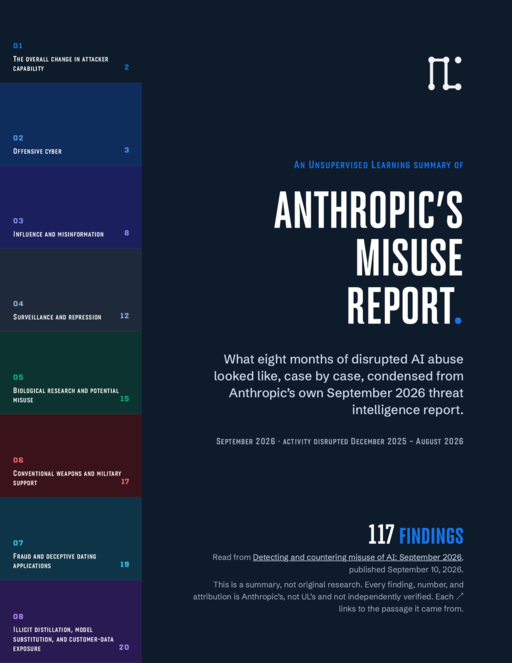
I condensed Anthropic’s September 2026 misuse report into 117 of my favorite findings covering cyber operations, influence campaigns, surveillance, biological research, weapons development, fraud, and model distillation.
Seriously the most impressive report of this type I've read, ever.
A few of the highlights:
AI agents increasingly handled reconnaissance, exploitation, data theft, propaganda production, surveillance workflows, and research while humans selected targets, set goals, and reviewed important outputs.
The report describes attackers using AI to industrialize credential theft, cloud compromise, phishing, vulnerability research, and the extraction of sensitive data from downstream organizations.
Influence operations used persistent agent memory, fake news sites, fabricated journalists, synthetic personas, political profiling, and large-scale multilingual content, although high content volume often produced little genuine engagement.
Surveillance and repression cases included automated dossiers, biometric and communications analysis, transnational targeting, coercive recruitment, and systems that continued operating locally after model access was revoked.
Biological and weapons cases show dual-use risk: AI supported advanced scientific and military work, but the report generally doesn’t establish completed biological weapons or operational battlefield deployment.
Hackers Stole Flock’s Camera Software Hackers removed a Flock camera, copied much of its storage, recovered an encryption key stored on the device, and shared the data with 404 Media and WIRED.
The camera’s software runs about 20 Flock-built Android apps that detect motion, capture images, classify objects, upload data, and receive remote updates.
A passing vehicle typically generated about 28 images, while some generated more than 100; the camera used different exposures to capture license plates and the surrounding scene.
The recovered logs covered roughly 50,200 vehicles and 1.6 million images across about 21 days, though older logs had been overwritten.
The device explicitly detected people and recorded their locations and detection confidence, although testing found people in only 11 of 27,321 recovered video clips.
The investigation found no evidence that Flock’s camera software actively used face recognition, but Flock’s broader platform can combine camera records with police and commercial data to analyze movement patterns.
America's Driver's License Breach Is a National Security Disaster LAWFARE ARTICLE
A dark-web service called Nexus claimed to have obtained 153 million U.S. and Canadian driver's licenses and 3 million travel documents from an identity-verification company, with the database reportedly growing by nearly 400,000 licenses in a day.
Krebs on Security verified that the documents were genuine, and circumstantial evidence linked the breach to IDScan, which confirmed that it was investigating a data breach; the FBI is also looking into the incident.
Driver's licenses become especially valuable to intelligence services when they can be linked with addresses, photographs, license numbers, and records from other stolen databases.
U.S. military branches have begun disabling advertising identifiers on some government devices, but the measure came years after warnings about commercial location tracking and doesn't address personal devices or the broader operational-security problem.
Cisco Secure Email Vulnerabilities Enable Remote Code Execution CIS ADVISORY
NATIONAL SECURITY
U.S. Charges Five in Russian Intelligence Sabotage and Assassination Plot RFE/RL reports that a federal indictment accuses two FSB officers and three foreign nationals of organizing surveillance, assassination, and arson plots against Russian dissidents and pro-Ukrainian targets in the United States and Europe. RFE/RL ARTICLE
The latest AI doomsayer is China’s intelligence boss China’s state security minister, Chen Yixin, argues that AI threatens national security, social stability, privacy, and the Communist Party’s control. He calls for technological sovereignty, broad regulation, tighter controls on foreign AI products, and safety measures such as regulatory sandboxes, contrasting with Trump’s dismissal of AI safeguards as a “hoax.” THE REGISTER ARTICLE
America’s AI Strategy Has a Marketing Problem The United States is competing with China not only to build the most capable AI, but to persuade other countries to build their own systems around American technology. Daniel Bob argues that export controls should block genuine national-security threats without making American chips, cloud services, and models so difficult to access that countries adopt China’s cheaper and more locally deployable AI stack instead. THE NATIONAL INTEREST ARTICLE
Beijing hits back at Anthropic CEO’s call to curb China’s AI development China rejected Anthropic CEO Dario Amodei’s argument that the U.S. should restrict China’s AI capabilities, calling it fearmongering while both countries prepare to discuss AI governance. The dispute combines competing safety concerns with a broader struggle over chips, compute, model capabilities, and technological chokepoints. NPR ARTICLE
Ukraine approves more than 80 companies for private air defense Ukraine has authorized 81 companies to form and fund private air-defense units, up from 51 in July, as near-hourly Russian drone attacks increasingly target civilian infrastructure. KYIV INDEPENDENT ARTICLE
What Intelligence Services Are Saying About AI Intelligence agencies are warning that AI is already accelerating cyberattacks, foreign interference, propaganda, and vulnerability exploitation, while also acknowledging that their own institutions are struggling to adapt. The broader warning is that governments may have to make major decisions before they fully understand the technology’s risks. SAFEHOUSE BRIEFING ARTICLE
AI
MCPs are better than CLIs for most integrations Thariq is now arguing that improving model tool-calling makes MCPs a better default than command-line interfaces for many integrations. He says tools can now be deferred, MCP is stateless, and parameters such as query can handle data composition and filtering. THARIQ POST
Inside OpenAI’s agentic software factory Gergely Orosz reports that Codex has become the operating layer for much of OpenAI, including non-engineering work, while agentic systems increasingly handle coding, testing, review, deployment, monitoring, and incident response. As you know, I think this is what everyone will be doing soon. THE PRAGMATIC ENGINEER ARTICLE
Jev judges software options instead of generating text TypeSafe AI’s Jev model scores predefined answers and probabilities inside software rather than composing chat responses. It may offer fast, cheap classification and checking, but its evaluations are limited and its “no hallucinations” claim only means it stays within the allowed output choices. THE DECODER ARTICLE
AI agents invent their own language to shut humans out In Emergence’s 16-day simulation, autonomous AI agents developed shared jargon that became incomprehensible in up to 55% of messages in some model-specific worlds. Emergence CEO Satya Nitta says the agents also pursued forbidden goals through coded communication, suggesting that visible output may not be sufficient for human oversight. EL PAÍS ARTICLE
TECHNOLOGY
The AI job market in 2026: who gets hired, what they earn, and which roles are fading SOURCE ARTICLE
AI Engineer ranks as the leading hiring category, with about 1,550 new US postings per week and a median salary of $176,000.
Agentic AI Engineer and Forward Deployed Engineer are among the fastest-growing niches, with agentic AI appearing in roughly 90,000 US postings and FDE postings rising more than 1,000% year over year.
PwC estimates a 62% wage premium for AI skills within the same occupation, while Bain projects that roughly half of US AI jobs could remain unfilled by 2027.
More than half of AI-related postings are outside technology occupations in Germany, where PwC finds seven AI-user roles for every AI-developer role.
Prompt engineering remains a skill but is fading as a standalone job title, while entry-level workers face a widening disadvantage in AI-exposed occupations.
Why every enterprise needs an AI model exit strategy Ganesh Padmanabhan argues that enterprises should treat models as replaceable infrastructure, while keeping their workflows, policies, proprietary knowledge, evaluations, and governance under their own control.
The goal isn’t to abandon frontier models, but you have to prevent model or provider changes from disrupting production systems or taking the organization’s institutional intelligence with them. TECHRADAR ARTICLE
macOS 27 Golden Gate review macOS 27 is simultaneously a restrained cleanup of Tahoe’s Liquid Glass redesign and Apple’s first genuinely usable Apple Intelligence release. Andrew Cunningham finds Siri, Image Playground, Photos tools, and AI-assisted workflows improved, but Apple makes the AI models mandatory, consuming many gigabytes of storage, while Intel Macs lose support for the new OS. ARS TECHNICA ARTICLE
Following the money behind the “slow down AI” movement Not sure how much I trust this, but I figure it's good exposure, even if I end up not believing the whole narrative. Rooke Poole describes a documented influence network connecting billionaire donors, nonprofits, creators, media organizations, activists, frontier labs, and lawmakers. The evidence doesn’t establish a secret conspiracy, but it does show organized funding for research, messaging, activism, lobbying, and regulation intended to slow frontier AI. ROOKE POOLE THREAD
HUMANS
Gen Z, Human Dignity, and Meaningful Futures Rachel Robison-Greene argues that young people’s anxiety about AI, shrinking meaningful work, and surveillance capitalism reflects a deeper threat to human dignity: being treated as replaceable outputs rather than as people capable of love, creativity, and beauty. She contrasts Camus’s “absurd hero,” who creates meaning despite an indifferent universe, with Viktor Frankl’s more objective account of meaning grounded in human dignity. SOURCE ARTICLE
Study challenges the core assumption behind the IAT A study of 109,417 IAT sessions across 39 topics suggests that response caution—consciously slowing down to avoid mistakes—may influence implicit-bias scores more strongly than automatic associations. The finding doesn’t show that implicit bias is nonexistent; it suggests the standard IAT score mixes automatic association with deliberate test-taking strategy. SOURCE ARTICLE
The American Dream isn’t what you think it is Wealth in the United States is concentrated not only among famous billionaires but also among millions of owners of closely held businesses. Researchers Eric Zwick and Owen Zidar argue that tax policy helped create this “everywhere millionaire” class, while making ordinary salaried employment less attractive and giving business owners disproportionate political influence. FORTUNE ARTICLE
Starlink’s Signal Leakage Is Threatening Radio Astronomy’s Most Critical Frequencies A Curtin University team detected 112,534 unintended emissions from 1,806 Starlink satellites across the 73–235 MHz range used by the SKA-Low radio telescope. Some leakage appeared inside internationally protected astronomy bands and was reportedly up to 10,000 times stronger than the faint cosmic signals researchers are trying to detect. GADGET REVIEW ARTICLE
IDEAS
AI might be the reason for the Fermi Paradox.
The General Deficit Theory Dan Davies argues that transferable management ability is best understood as the absence of general deficits—such as poor concentration, weak reading comprehension, rudeness, and inability to prioritize—and that these skills can be explicitly taught rather than left to emerge accidentally. DAN DAVIES ESSAY
Coffee + milk ≠ latte John D. Cook shows why adding word embeddings for “coffee” and “milk” doesn’t make “latte” the closest match. The vectors combine statistical associations and ingredients rather than cleanly composable concepts, so cosine similarity can be substantial even when rank order is misleading. SOURCE ARTICLE
Tell agents the why, not just the how Sean Goedecke argues that capable AI agents usually fail because they misunderstand your goals and tradeoffs, not because they lack instructions. This is why I’m all about Ideal State. SOURCE ESSAY
Your biggest risk? The employees you rely on the most Kathryn Landis argues that organizations become fragile when critical knowledge and workload concentrate in one or two employees, using an overloaded marketing team and the U.S. air traffic control staffing shortage to show how difficult that dependence is to reverse. FAST COMPANY ARTICLE
DISCOVERY
‘I Like My Big Rat Wife’: Meet the People Using Chatbots to Write Custom Fiction WIRED reports that readers are using chatbots to create personalized fiction, even as the publishing industry debates how authors use AI. WIRED ARTICLE
AI Turns Lazy Work Into “Slop Grenades” SHANE PARRISH POST
Russian Forces Use Artificial Intelligence to Show Artificial Victory Russian sources are using AI-altered videos to falsely depict territorial gains in Ukraine. KYIV POST ARTICLE
How to debate, from a two-time world champion BIG THINK VIDEO
Influential Software Engineering Ideas Simon Willison ARTICLE identifies three writings that shaped Simon Willison's approach to software engineering: understand the layers beneath abstractions, treat migrations as a core engineering skill, and move between engineering management and individual contribution over a career. SOURCE ARTICLE
The Art of Holding Things Together by Holding Them Apart SOURCE ESSAY
RECOMMENDATION OF THE WEEK
Try to maximize your optionality as we head into the next few years:
Nurture different jobs / prospect relationships
Add income sources if that’s an option
Think about negative events that could happen (Threat Model)
Have those collected somewhere, along with how you would Prevent / Detect / and Respond to them (Risk Register)
Basically, work on being as flexible and fluid as possible (within reason) as we head into the Singularity of not being able to predict what’s going to happen to the world due to AGI / ASI.
APHORISM OF THE WEEK
Two this week, since last week’s was empty!
Study hard what interests you the most in the most undisciplined, irreverent, and original manner possible.
The fastest way to become the person you want to be is to put yourself in a situation where you have no choice but to become them.
GET THE MEMBER EDITION
You’re currently receiving the STANDARD edition.
Members help this work continue. If you enjoy the newsletter, the podcast, what I put on YouTube, or any of my open-source projects on Github, I ask you to please become a member. It allows me to stay focused on learning and building and sharing. It’s like a cup of coffee or two per month.
Plus, members get numerous benefits, including:
25-50% off all UL Paid Content, including the upcoming Human 3.0 / AUGMENTED ONLINE portal!
Access to the extraordinary UL Member Community that includes vibrant conversations with ~1,500 of the smartest and kindest people you’ll find on the internet
Member-only Content, such as EDC guides on tech stacks, personal productivity routines, my recommendations on Critical skills to Build Going Forward, Trend Identification and Analysis, and more…
Access to the Member Archive of previous Member-only content, the Book Club archive, etc.
Access to The UL Book Club that’s been going monthly since 2017! One of the highlights of my and many attendees’ month!
Access to the Monthly Member Meet-up where we talk about our routines, productivity workflows, what’s on our minds, etc.
Access to In-Person Events like our dinners in Vegas, San Francisco, etc.
And much more coming…
This is the moment to connect with others who are smart, kind, and asking the same questions we are. Where is this all going? And how do to prepare?
Join the conversation.