


UPDATES
Hey! Hope you all are doing well!
This video brings me tremendous joy.

So so good, because it’s true
An Unhealthy Place
Getting ready to go on a health push. Actually just getting back to normal from around a year ago.
Basically around this time in 2025 is when things went wonky for me. Because of Claude Code. Then it happened again in November of 2025.
Sleep was destroyed. And from there, diet. Exercise has been off and on.
But in general I’ve just been less healthy, lower muscle mass, worse sleep. Haven’t done my spring cleaning yet, which I planned to do before January 1st. Cleaning clutter, selling stuff, etc. Lots of small house projects I need to do. Etc.
Basically all bad, and it’s currently the perfect time to get back on routine (there is a lull in the releases/hype starting to happen that’s perfect timing).
If you’re in a similar floating capsule, do it with me.
—
Thoughts on AI Adoption Speed
One of the most talked about AI topics is the speed of AI adoption in companies, and the reasons for it.
I want to give some (seemingly) contradictory frames here that I use to think about this myself, and that I hope will be useful to you:
There is massive hype around AI
There is too little hype about how big this is
It’s way overblown in many cases, by many people
Companies have always wished they could do the work themselves, not needing people, just like automated factories
Some number of people are still needed in pretty much every company
The smarter and more well-rounded you are, and the better you are with using AI, the more safe (and desirable) you are to companies—even after AI takes hold
Every company has a different calculus for what types of human employees they need, and it varies by team, department, etc.
Some functions will get completely crushed by AI very fast; others will take a very long time or (basically) never get converted
The vast majority of people who resist / refuse using AI will be at a tremendous disadvantage in the workplace (probably not famous wood-workers, for example, but most other people)
The overall tendency in all companies will be to automate as much as possible with AI
Once most of a company is automated with AI (which will take a long time) it will make the remaining human roles even more important (what and why, vs. how)
It’s easier to automate roles and people where those things weren’t being done very well, or very consistently
Adding AI well inside of businesses will likely create more work, not less. The question is what/who will do that extra work
Some amount of the extra work created by AI will be done by AI, but some amount will require humans. The issue is that the capability bar for which humans will continue to rise, even as AI enables companies to do more and more
Just because AI makes more work for everyone doesn’t mean that those who have been phoning it in will be safe. The bar will continue to rise, and it will be at different levels for different industries, companies, teams, etc.
Many people are vulnerable to replacement by AI in their current form, but they would be highly marketable if they became what I call a Human 3.0 version of themselves. This means: they know who they are, they know what they’re good at, they’re great at articulating that, and they’re an expert at using AI to magnify their human capabilities
This means the main response we should have to AI as humans is not to panic (although some of that is understandable), but rather to downshift into a more powerful version of ourselves. A version that is actually MORE desirable in a world full of AI. Because once AI has covered all the stuff that can be done with AI, the stuff that remains will be the most important stuff in the world. Making, building, creating, etc.
The people saying AI will replace all jobs in like 1-3 years are dead wrong. It takes forever to change anything
Even if most companies were presented with a magic God button that tripled profits by pressing it, it would still take multiple months or years to get the meetings together to press it
The people saying that AI won’t replace jobs because humans do the work better are dead wrong. It’s happening. And nobody is doing it. It’s just happening. It’s happening to your company; it’s not your company doing it to you.
A crude way to think about this is to take the people who say it won’t happen and the people who say it will happen in 2 years and find the middle line
A great heuristic for this is the saying that we overestimate major changes in the short term and underestimate them in the longterm.
My guess is that AI adoption is probably the most powerful example of this we’ll ever see
—
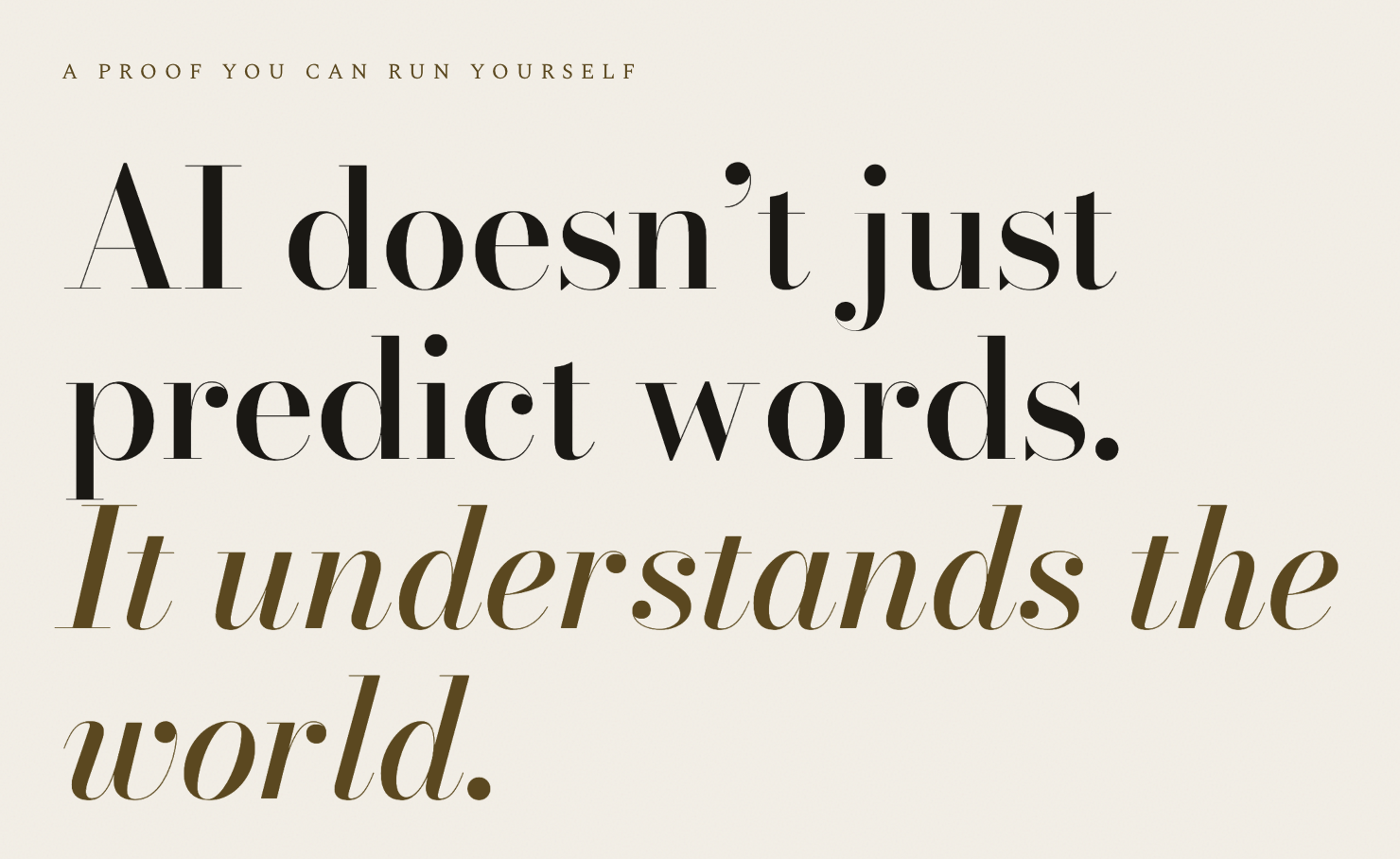
I created a website that argues, and demonstrates, that AI actually has to understand the world to do what it does. aiunderstands.ai
The central idea that people don’t get about the next-token-prediction argument is that LLMs aren’t just next-token-predicting random text. They’re next-token-predicting the text of THE ANSWER.
And in order to predict the next token in an answer they first have to…..(checks notes)…….figure out the answer.
And to show this, I created completely new murder mystery scenarios that use non-natural physics, which NO AI HAS EVER SEEN (I’ll keep regenerating them because they’ll get scraped).
Even young humans won’t be able to solve these because they require some level of logical thinking and detective-like skills. And there’s nothing to “auto-complete” because none of these scenarios are in any training data.
If AI can solve them, it’s because it’s thinking through the characters, clues, and physics and running them through some sort of causal world model. And if you turn thinking on, in ChatGPT or wherever, you can actually see it do this!
So, yes, AI does understand the world. It doesn’t experience the world (that we know of), but it understands it in the sense that it can connect concepts, and physics, and play things out in that universe to solve problems.
—
New blog on how I’m thinking about AI right now, and especially in relation to these IPOs that are starting to happen.
Some killer content in here that started with IPO comments but ended up being a really good summary of how I currently see AI.
—
Looking forward to this event with Elastic Security on June 17th. You’ll hear about their agentic security operations platform where autonomous agents handle the full lifecycle from ingestion through response. I’ll be on with them talking about current attackers, and the ways to defend. You can sign up here!

Join us for the event!
Sponsor
AI agents that find and fix vulnerabilities
The majority of your vulnerability backlog, ~80% on average, isn't exploitable in your specific environment. But your tools don’t tell which is which, so the backlog grows and real risk sits next to noise.
Maze AI agents investigate every finding the way your best security engineer would if they had all the time in the world. They gather context from your real configuration, controls, and environment, then tell you what's exploitable, why it matters, and how to fix it.
No more chasing "criticals" that don’t matter. No more tickets sitting because nobody knows where to start or how to fix it. Just the findings that matter, with the answers attached.
CYBERSECURITY
Bug hunter leaks Microsoft exploits instead of waiting A researcher dropped a VS Code exploit an hour after disclosure (way before any fix was possible) and used it to steal OAuth tokens. THE REGISTER ARTICLE
Meanwhile, Microsoft turns OpenClaw into a work agent Microsoft is taking OpenClaw and wrapping it in enterprise controls for regular office workers. Bad news week combination with all this researcher stuff. DECRYPT ARTICLE
Attackers spread 34 poisoned packages to steal cloud keys and wallets TrapDoor slipped malicious code into npm, PyPI, and Crates.io just by installing or compiling. It grabs SSH keys, AWS secrets, API tokens, and even rewrites AI config files for persistence. CYBERSECURITYNEWS ARTICLE
The U.S. releases a more reserved AI/Security order after pushback This executive order pushes agencies to harden systems, build an AI model benchmarking pipeline, and speed vulnerability patching. It also sets criminal enforcement priorities for AI-enabled hacking.
Agencies must prioritize cybersecurity for national security systems fast
Treasury, DHS, NSA coordinate an AI vulnerability scanning clearinghouse
Models get benchmarked and may be labeled “covered frontier”
NSA-style “covered frontier model” thresholds rely on classified testing process
Criminal enforcement targets AI-assisted unauthorized access and damage directly
Red Hat pulls tainted packages after GitHub account worm attack Red Hat found attackers pushed credential-stealing malware into 32 packages via a compromised GitHub account. The worm code’s public release also enabled copycats, so attribution is muddy. THE RECORD FROM RECORDED FUTURE NEWS ARTICLE
Sponsor
You know AI attacks are coming.
Your organization doesn’t.
If you're reading Unsupervised Learning, you already understand how cloned executive voices, OSINT-targeted spearphishing, and deepfake video calls work.
Your employees don't — until they experience them.
Adaptive Security lets you run those exact simulations against your org, across email, SMS, and voice. Trusted by Ramp, Perplexity, Figma, and Plaid.
NATIONAL SECURITY
European officials warn Russia is stealing Western tech Kyiv Post says Russian intelligence is shifting to aggressive industrial espionage, using middlemen and shell companies to bypass export controls. KYIV POST ARTICLE
Taiwan tests armed robot patrol dogs for South China Sea islands Taiwan is trying to keep tiny islands watched without staffing more people there. Armed quadrupeds are part of the pitch, but it’s still just a demo. THE NEXT WEB ARTICLE
DARPA wants PINPOINT to navigate without GPS when it gets jammed DARPA’s PINPOINT program targets a new GPS-independent inertial sensor class for battlefield resilience. It takes on the MEMS IMU nonlinear performance plateau using nonlinear dynamics and materials, plus an integrated “tesseract” sensing architecture. Which is exactly how I’d have done it, obviously. DEFENCE BLOG ARTICLE
Military spending is starving Russia’s civilian economy, per IISS Russia’s overheated military sector is pushing up capital, labor, and goods costs, plus taxes. That’s turning into a dual economy of stagnation below the war machine. NV.UA ARTICLE
Chinese scientists built a drone-swarm algorithm that hunts through jamming The new HG-STR system tags objects with meaning, learns fast, and coordinates swarms when comms fail. SCMP ARTICLE
AI
AI is showing up in US GDP way faster than stats track Quality-adjusted AI production jumped 2,000%+ per year in 2024–2025, mostly from algorithmic progress and data centers. MARGINAL REVOLUTION ARTICLE
Amazon kills internal AI leaderboard after people gamed it hard Amazon shut down its “Kirorank” dashboard after workers inflated scores with pointless agent runs. Goodhart’s Law strikes again. THE DECODER ARTICLE
Anthropic just overtook OpenAI and is barreling toward $1T Anthropic raised $65B and is now valued near $1T. So basically it looks they’ll be first to two major things: $1 Trillion dollars (pinky thing), and arguably more importantly—profitability. KAZINFORM NEWS ARTICLE
Claude Code is basically a registry-and-agent play, not coding This piece says Claude Code works best when teams stop thinking in code and start composing workflows via tools and context. I obviously agree. Vlad Temian BLOG
TECHNOLOGY
AI is making math less important than creative communication AI shifts hiring toward storytelling and language skills. I think the best framing is end-to-end, which includes being able to come up with a solution, build it, and then tell the story / sell it. FORTUNE ARTICLE
AI is growing way faster than GDP can see it Researchers say AI is already a giant part of the economy, but the accounting system barely notices. PIIE POLICY BRIEF
AI output is exploding far faster than GDP records
Compute spending jumped from $37 billion to $219 billion in two years
Quality-adjusted output rose about twenty-three times a year
Standard stats miss it because AI cuts across old industry buckets
The fix is better accounts, better data, and earlier policy planning
OpenAI wants robots first, then personal robots for everyone OpenAI is rebuilding robotics to support infrastructure builders now, then general-purpose consumer robots later. It's so weird that we haven't even finished fighting this AI battle, and we're already starting to fight the robotics battle. THE DECODER ARTICLE
RSS is back, because AI agents need predictable content feeds RSS stayed alive, and agents rely on protocol consistency more than people do. JULIEN RESZKA BLOG POST
Nvidia is pouring billions into photonics to beat copper limits Nvidia is betting on light-based AI networking by funding the photonics supply chain at massive scale. THE NEXT WEB ARTICLE
HUMANS
Sam Altman walked back the jobs apocalypse claim and explains why TIME says OpenAI’s CEO now thinks AI won’t nuke white-collar work like he predicted. See my comments about this in the intro. TIME BUSINESS ARTICLE
Google’s Verily wants to release 64 million Wolbachia mosquitoes in two states Verily is asking the EPA to approve Wolbachia-carrying male mosquitoes that can’t produce eggs, cutting Aedes populations.
Verily asks the EPA to release up to 64 million males
Wolbachia males mate, and wild females’ eggs fail to develop
Fresno trials hit 95%+ biting reduction; Singapore saw 70%+ dengue reduction THE NEXT WEB ARTICLE
AI tutoring beats peer law professor answers in blind tests STANFORD LAW SCHOOL ARTICLE
Wix cuts 20% of staff because AI and currency stress collide Wix is laying off about 1,000 people after Abrahami said the shekel got stronger and AI is reshaping roles. THE NEXT WEB ARTICLE
Amazon kills internal AI leaderboard after people gamed it hard Amazon shut down its “Kirorank” dashboard after workers inflated scores with pointless agent runs. THE DECODER ARTICLE
IDEAS
Popperians and Bayesians miss Ramsey’s universal-as-habit move Bayesians and Popperians argue about induction, but Ramseyian logic treats universal claims as variable rules that generate testable singular beliefs. LESSWRONG POST
Utopia breaks the moment you give everyone infinite options Caleb Biddulph adapts a utopia epilogue to show how “perfect” power still leaves tradeoffs, consent issues, and people opting out. LESSWRONG ESSAY
DISCOVERY
The Goal of Good Branding is making people feel understood Alex Hormozi argues great branding is basically clarity, and it earns attention by reducing friction and confusion for real buyers. ALEX HORMOZI YOUTUBE VIDEO
SQLite is All You Need for Durable Workflows OBELISK BLOG POST
RECOMMENDATION OF THE WEEK
Going to try to switch to more voice texts.
Way more personal: somewhere between a text and a call.
APHORISM OF THE WEEK
The essence of the independent mind lies not in what it thinks, but in how it thinks.
GET THE MEMBER EDITION
You’re currently receiving the STANDARD edition.
Members help this work continue. If you enjoy the newsletter, the podcast, what I put on YouTube, or any of my open-source projects on Github, I ask you to please become a member. It allows me to stay focused on learning and building and sharing. It’s like a cup of coffee or two per month.
Plus, members get numerous benefits, including:
25-50% off all UL Paid Content, including the upcoming Human 3.0 / AUGMENTED ONLINE portal!
Access to the extraordinary UL Member Community that includes vibrant conversations with ~1,500 of the smartest and kindest people you’ll find on the internet
Member-only Content, such as EDC guides on tech stacks, personal productivity routines, my recommendations on Critical skills to Build Going Forward, Trend Identification and Analysis, and more…
Access to the Member Archive of previous Member-only content, the Book Club archive, etc.
Access to The UL Book Club that’s been going monthly since 2017! One of the highlights of my and many attendees’ month!
Access to the Monthly Member Meet-up where we talk about our routines, productivity workflows, what’s on our minds, etc.
Access to In-Person Events like our dinners in Vegas, San Francisco, etc.
And much more coming…
This is the moment to connect with others who are smart, kind, and asking the same questions we are. Where is this all going? And how do to prepare?
Join the conversation.